
Greece Previous Residents by Era
Previous residents leave different kinds of records in different periods. Start with the latest parcel record to stabilize the address, then move backward through the deed chain. Add the Rochester Public Library’s street sections and census schedules when the question is about households rather than ownership. Historical sources often use North Greece, Rochester, Hilton, rural-delivery, or other post-office language, so record the address, parcel, legal description, and neighboring entries together.
| Source | Years It Covers | Where Held | What It Shows |
|---|---|---|---|
| Monroe digital deed/index route | generally post-1975 modern records; exact SearchIQS year/filter must be confirmed | County Clerk / SearchIQS | grantor/grantee, instrument, book/page or document number, date, legal description; image/account conditions |
| Monroe deed books and microfilm | pre-1975 historical route; exact earliest Greece deed not located | County Clerk downtown | conveyances, legal descriptions, signatures, and prior references |
| Greece assessment rolls | 2025 final and 2026/current roll links verified; complete older online run not located | Town Assessor / Monroe RPTS | owner, mailing and situs fields, value, exemptions, districts, and deed reference |
| Greece suburban directories | digitized 1930-1940; original bound volumes from 1930 | Rochester Public Library | resident names, spouse/initial, occupation, street, owner mark, and post-office label |
| Rochester city directories | physical 1827-present; digitized 1827-1946 | RPL Local History & Genealogy | name and street listings, ads, institutions, and varied Greece coverage |
| Federal census | public through 1950 under the 72-year rule | NARA / RPL / in-library databases | household composition, age, birthplace, relationship, and address or geography |
| Building and inspection files | public online start not located | Greece Building Department / FOIL | permits, plans, inspections, applicant or owner, and construction-change clues |
| Newspapers and obituaries | RPL index 1818-1897; complete Greece run not located | RPL and Greece Historical Society | moves, deaths, anniversaries, civic events, and property references |
| Probate | year or index number needed | Monroe Surrogate’s Court | fiduciary, beneficiaries, addresses, and estate distribution |
For a newer transfer, begin at the County Clerk index. For a 1930s household, begin with the House and Street section, then use the deed chain to test an owner mark. For a much older address, use the city-directory, newspaper, plat, and probate routes as leads, not as substitutes for a recorded deed.
Start Greece Past Residents with the Parcel
The Town Assessor and Monroe County Real Property Services provide the present-day anchor for a Greece address. Capture the property location, tax-map number, current owner, owner mailing address, assessment year, prior owner, and deed book/page when shown. The parcel and legal description will survive address vocabulary changes more reliably than a name. In the sampled 2025 roll, the situs and owner mailing address are separate fields. The mailing field directs tax correspondence; it is not evidence that the owner lives at the parcel.
That distinction keeps the previous-residents trail honest. An assessment entry can point to a transfer, but it does not identify every past occupant. A deed can establish a transfer, but it does not prove who slept at the address. Household evidence belongs in directory, census, newspaper, and probate research.
Trace Greece Previous Owners Backward
The Monroe County Clerk’s historical deed method is the core ownership trail for Greece previous residents. Begin with the current owner’s purchase, identify the seller, and search that seller as the prior buyer. That seller-as-grantee move is the useful local shortcut. Preserve each instrument date, liber and page or document number, legal description, municipality, parcel number, and prior reference before moving back another step.
- Pull the current Greece parcel and legal description from the assessment roll or property route.
- Find the owner’s purchase in the Clerk’s recorded-document index and note the seller, instrument date, legal description, and liber/page or document number.
- Search the seller as grantee to locate the seller’s earlier acquisition of the same parcel.
- Repeat the seller-as-grantee step, matching the legal description and tax-map number rather than relying on a surname alone.
- When the chain reaches the earlier records, retrieve the liber/page through the Clerk’s historical index books and microfilm.
- Grantor
- The person or entity conveying an interest in the recorded instrument, commonly the seller in a deed.
- Grantee
- The person or entity receiving that interest, commonly the purchaser named in the deed.
- Chain of title
- The linked series of recorded transfers for the same land, followed backward from a known deed.
- Legal description
- The lot, subdivision, metes-and-bounds, road, or parcel language that identifies land more reliably than an old street address.
Use Greece Past Residents SearchIQS
The Monroe County Clerk directs modern recorded-document research to SearchIQS, generally for post-1975 records. The live guest view showed entry points for a guest, account, login, and subscription but did not expose every field during research. Confirm exact current filters and image conditions at the official portal or public terminal. The historical guide, not an assumed online cutoff, controls the older deed method.
For pre-1975 instruments, go to the Clerk’s downtown office at 39 W. Main Street, Rochester, and use the grantor/grantee index books by year and first letter of the grantee surname when no liber/page is known. Once the book and page are found, retrieve the matching microfilm reel. County subscription information says public terminals provide index and image access at no charge, while access from home can depend on account or subscription conditions.
The County Clerk’s records access page is the source for the Greece previous-residents deed route.
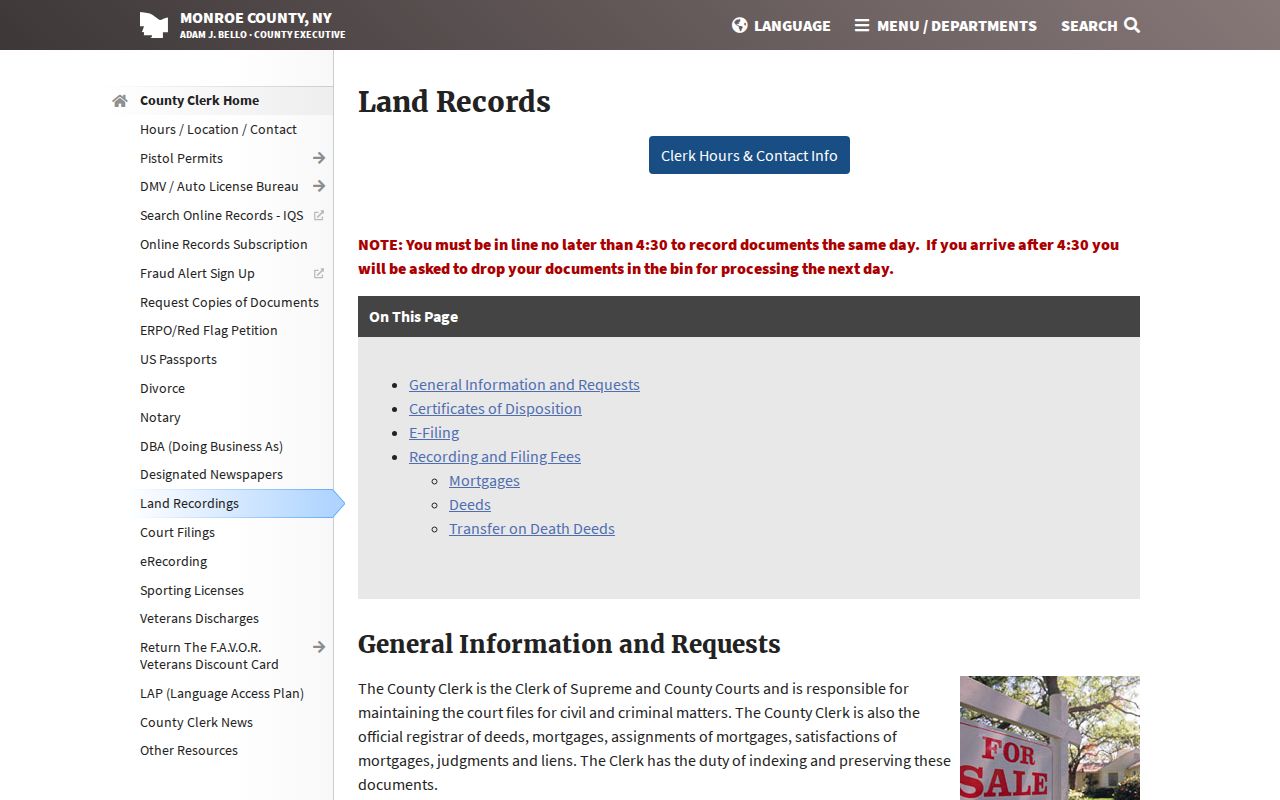
On April 1, 2026, standard indexes remained free to search and review while digital original documents moved behind a subscription, making the public terminal and microfilm route especially important for older Greece transfers.
Note: Record the liber/page and document number before leaving a result, since they are the handoff between index, image, and office research.
Bridge Greece Previous Residents Addresses
Street names, rural delivery labels, postal wording, and municipal boundaries can interrupt a previous-residents search. Greece was formally established on March 22, 1822 after being Northampton and part of Gates. Charlotte was annexed to Rochester in 1916. Earlier records may instead refer to Charlotte, North Greece, West Greece, Greece Center, Barnard Crossing, or Paddy Hill. A current Rochester postal label is also not proof that an older record lies outside the Town of Greece.
Use the legal description, parcel number, subdivision or lot, road name, neighboring entries, and old intersections to bridge those terms. The Town Historian and library recommend checking street-name changes and variant spellings, but research did not locate a verified Greece-wide street-renumbering year. Do not attach an unverified date to an address change. Treat each old label as a search lead that must be tested against land identifiers.
Pair Greece Previous Residents With Census
The Rochester Public Library has digitized Greece suburban-directory PDFs for 1930 through 1940 and retains original bound volumes from 1930. Open a House and Street section at the address, then look up the same surname in the alphabetical section. Record the spouse or initial, post-office label, owner symbol, and neighboring entries. The 1939 House and Street format marked resident property owners with a symbol, but its publisher warned that canvasser information is not legal proof of title.
Next, pair the directory year with the closest public federal census schedule. Census pages are public through 1950 under the 72-year release rule and may show household composition, relationship, age, birthplace, and geography. A directory omission can reflect a child, a person without a fixed address, a compiler omission, or coverage limits. A census and a directory support a dated household picture; neither changes the recorded owner listed in a deed.
The Greece city directory collections describe the library shelf and directory formats in more detail. For the address-led current parcel sequence, use the Greece street directory.
Build Greece Previous Residents House History
Rochester Public Library’s House History guide advises starting with a deed and working backward, then adding directories, maps, newspaper clippings or indexes, plats, and local files. The guide is clear about the limit: a chain of title identifies owners and legal property descriptions, not necessarily who lived there or the exact construction date. Sanborn maps can help date building footprints, use, additions, and neighborhood change, but exact Greece Sanborn years were not located in the official sources reviewed.
RPL Local History holds city and county plats, Sanborn fire-district maps, newspaper microfilm, and the Local Rochester Newspaper Index for 1818-1897. Some materials have handling limits, and the library notes that Sanborn maps are available in PDF form via CD rather than for photocopying. Ask staff for the relevant sheet or run, then compare it with permits, assessment sketches, deeds, and historic surveys.
Lawful house history. Greece previous-residents research is appropriate for family history, property history, estate questions, and civic research. Do not use historic or current address records to track, intimidate, or harass a living person; New York Penal Law §§120.45 and 240.30 restrict stalking and certain harassing conduct.
Find Greece Previous Residents Context
Newspapers, obituaries, photographs, and probate records can close gaps in a Greece previous-residents trail. The Greece Historical Society lists research routes for The Greece Press, Greater Greece Press, The Greece Post, Hilton Record, photographs, newsletters, programs, and local archives. Greece Images adds searchable captions for houses and farms, roads and maps, schools, community groups, transportation, people, and other local subjects. These are useful context sources, not a complete name index.
An obituary can connect an address to a spouse or family after a death. A Monroe Surrogate’s Court estate file, requested by decedent name, file or index number, or year, can identify fiduciaries, beneficiaries, addresses, and counsel when the material is not sealed. In South Greece, the 2025 Erie Canal Bicentennial Heritage Trail identified 29 canal-associated stops. A canal-road, farm, trolley, industrial, or neighborhood clue can guide a search in surveys and newspapers even when no modern name record answers the question.
Limit Claims About Greece Previous Residents
Past residents can be documented only to the degree each dated source supports. A tax roll identifies an owner and mailing field, not every occupant. A deed identifies a recorded transfer, not every household. A directory is a snapshot with its own coverage and possible omissions. A census is periodic, not continuous. Newspaper and obituary statements are leads that need comparison with the relevant custodian record. Keep conflicting spellings, addresses, and dates in the work record instead of forcing them into a single story.
Note: Verify a title, probate, permit, or boundary question with the office that holds the original record before relying on it.